
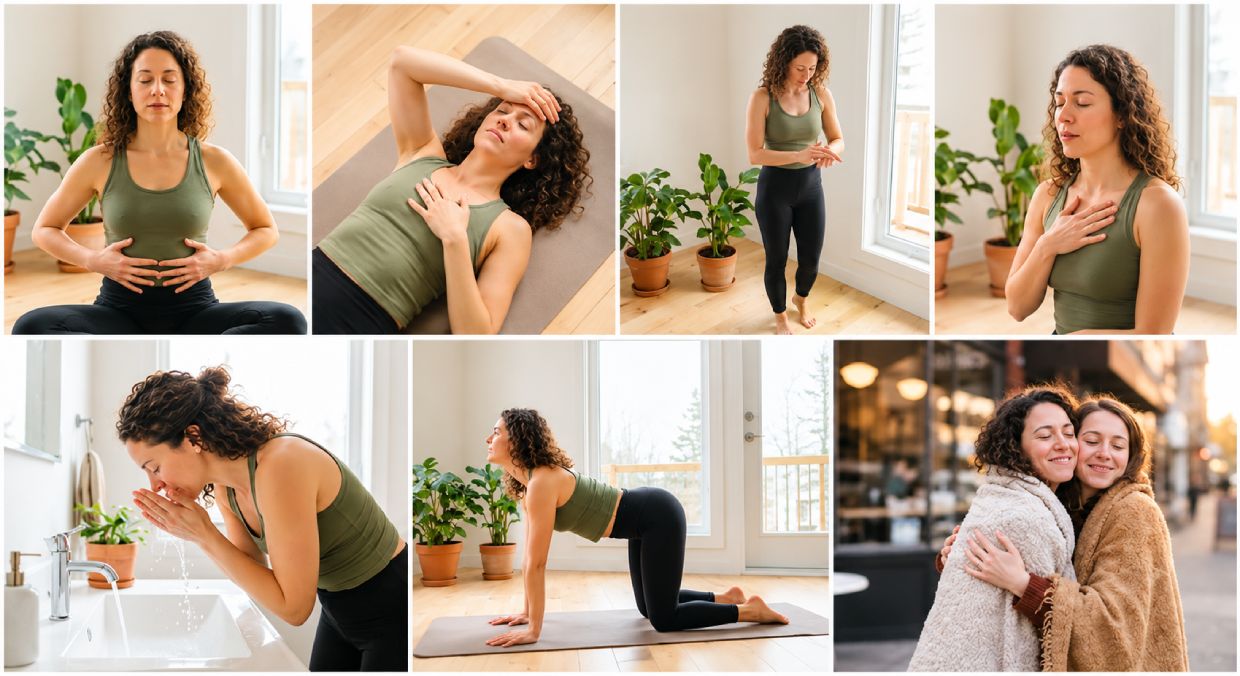
7 Daily Nervous System Regulation Exercises for Stress Relief
You can understand why you’re stressed and still feel your shoulders tighten when a particular name appears on your phone. You can recognize an old pattern while finding yourself halfway through it again.
Insight matters. So does what happens when you begin working with the experience as it unfolds: the held breath, the impulse to withdraw, the familiar story about what comes next.
Nervous system regulation exercises offer ways to participate in that process. Through attention, breathing, movement, and the quality of care you bring to yourself, you can begin exploring a different response.
In The Coherence Method™, I place these practices within a larger understanding of coherence: our capacity to remain connected and responsive as life becomes complex. Relief is welcome. But the work also involves becoming more able to feel what is happening, discern what it means, and respond with care.
The seven practices below offer different places to begin.
What Is Nervous System Regulation?
Nervous system regulation involves adjusting to changing demands and recovering from stress. It allows you to become alert when something requires attention, mobilize when action is needed, and settle when conditions permit.
That flexibility matters. There are moments when feeling energized, angry, or unsettled makes sense. A difficult conversation may call for a clear boundary. Grief may ask for time and companionship. Exhaustion may reveal that the demands on your life have become unsustainable.
Regulation helps create room to recognize these differences.
How Stress Responses Become Familiar
Your nervous system develops within relationships and environments. It learns from what happens repeatedly: whether help arrives, whether expressing a need brings care or conflict, whether the demands ever ease.
Some responses become familiar enough to happen before you consciously register them. You might tense in anticipation of criticism, become unusually agreeable during conflict, or feel distant when an experience becomes overwhelming.
In my work, understanding these adaptations is part of developing coherence. We become curious about what a response has helped us survive, what continues to evoke it, and what other possibilities are available now.
Where Relaxation Fits
Relaxation practices can support recovery from stress. Breathing exercises, progressive muscle relaxation, and guided imagery are among the approaches used for this purpose, although the strength of the evidence varies by practice and condition.
Feeling calmer can make it easier to listen, think, or rest. Yet calm alone tells us relatively little about whether someone feels connected to their experience. A person can appear composed while suppressing everything they need to say.
Throughout these exercises, consider a broader question: Am I becoming more able to meet what is happening?
Before You Begin: Find a Manageable Starting Point
The “window of tolerance” is a useful way to describe the range in which you can engage with experience without becoming overwhelmed or feeling profoundly disconnected.
There is no need to push toward the edge of that range. Begin with something ordinary and manageable. You might practice while sitting in your garden, taking a break from work, or preparing for sleep.
Keep your eyes open if that feels better. Change position. Shorten the exercise. If focusing inward increases distress, bring attention to your surroundings instead. Relaxation practices can sometimes increase anxiety or bring up difficult experiences, particularly for people with a trauma history.
Your response gives you information about what is useful today.
7 Daily Nervous System Regulation Exercises
1. Slow Diaphragmatic Breathing
Breathing offers a place to notice how effort and urgency move through your body. Under stress, you may hold your breath or breathe more rapidly without realizing it.
For this exercise, let comfort guide the pace.
How to practice:
Sit in a position that allows your ribs and abdomen to move easily.
Rest a hand on your lower ribs or belly, if helpful.
Inhale gently, allowing some expansion through that area.
Let the exhale leave without pushing or squeezing.
Continue for a minute or two, then notice how you feel.
If counting helps, try breathing in for four counts and out for four or five. Adjust the count to suit your breathing rather than struggling to complete it.
A longer exhale is an option, but it does not need to become a rule. Research comparing breathing ratios has not established a consistent HRV advantage for longer exhalations during slow breathing.
Within coherence practice, breathing can help you notice the relationship between your pace and the demands of the moment. Is there room to soften some effort? Do you need a pause before continuing?
2. Sensory Grounding
When attention becomes absorbed in anticipation or replaying an experience, sensory grounding offers contact with your present surroundings.
The familiar 5-4-3-2-1 exercise provides a simple structure.
Slowly notice:
Five things you can see: the shape of a leaf, a shadow, the edge of a table.
Four things you can feel through touch: the chair beneath you, your clothing, the floor.
Three things you can hear.
Two things you can smell.
One thing you can taste.
Adapt the sequence to your senses and surroundings. You can simply name colors or notice the surfaces supporting your body.
Let the exercise help you gather information. Where are you? What is happening around you? Is there something you need?
Sometimes grounding reveals that there is room to settle. Sometimes it helps you recognize that you need to leave a situation, seek support, or attend to a practical concern. Both observations matter.
3. Progressive Muscle Relaxation
You may only notice how tightly you have been holding yourself when something finally releases.
Progressive muscle relaxation introduces a gentle contrast between muscular tension and release. It is an established relaxation technique, though its effects vary across people and conditions.
How to practice:
Begin with your hands or feet.
Gently tense the muscles for about five seconds, without straining.
Release for ten to fifteen seconds.
Notice the difference.
Move through a few other areas, such as your legs, shoulders, and face.
Skip areas that are painful or injured. You can also practice noticing and releasing tension without deliberately tightening first.
Pay attention to the small discoveries. Perhaps your jaw tightens while you read email. Perhaps your hands brace when you try to explain yourself.
These observations can become useful feedback during daily life, helping you recognize effort before exhaustion becomes the only signal you can hear.
4. Coherence Practice: Focus, Activate, Radiate
This practice brings attention and emotion into a deliberate relationship. In The Coherence Method, I teach it through three movements: focus, activate, radiate.
Focus
Bring your attention to the energetic center of your heart. You can rest a hand over the center of your chest or simply allow your awareness to gather there.
Let your breathing remain comfortable.
Activate
Invite a positive or life-affirming emotion. You might recall affection for an animal, appreciation for someone who has shown you care, or a moment when you felt connected to the living world.
Give yourself time to sense whatever is available. A small feeling of tenderness is enough. If a particular memory brings more grief than warmth, choose another starting point or return to grounding.
Radiate
Allow that quality of feeling to spread throughout your body, reaching your face, shoulders, abdomen, hands, and feet.
Then imagine radiating it outward into the space around you. Let the practice extend your sense of care beyond the place where your attention began.
Working with past or future experience
Once the basic practice feels familiar, you can bring an earlier version of yourself to mind and radiate care toward that person. Or imagine an upcoming conversation and extend that same quality of presence toward yourself and the people involved.
These are contemplative adaptations for exploring your relationship with memory and anticipation. You can practice with an ordinary disappointment or a manageable concern; there is no need to revisit your most painful experience.
The energetic and spatial language here describes how to engage with the practice. Research on related approaches, such as breathing or HRV biofeedback, should be distinguished from evidence for this exact sequence and its adaptations.
5. Gentle, Attentive Movement
Sometimes movement offers an easier entry into awareness than sitting still.
Try a short walk, a few comfortable stretches, or slowly opening and closing your hands. You might roll your shoulders, reach overhead, or shift your weight from one foot to the other.
As you move, notice:
Where movement feels available.
Where you are adding effort.
Whether you want a slower or more energetic pace.
What happens when you pause.
You can include awareness of the environment: the temperature of the air, the ground beneath your feet, the sounds around you.
Movement also offers a chance to respond to a practical need. After hours at a desk, your body may need a change of position, daylight, or a break from sustained concentration.
Coherence includes listening to that information and allowing it to influence what you do next.
6. Self-Compassion Through Supportive Touch
Self-compassion becomes especially relevant when distress is followed by criticism: Why am I still like this? I should be handling this better.
Supportive touch can offer a physical gesture of care while you experiment with a different response.
How to practice:
Place a hand over your chest, on your abdomen, or around your opposite upper arm.
Notice the warmth and pressure of your hand.
Acknowledge something true: “This is difficult,” or “I’m feeling overwhelmed.”
Ask, “What would be a caring response right now?”
Give yourself a moment before answering.
You might need rest, company, food, help, or permission to postpone a nonessential task.
If touch feels uncomfortable, leave it out. You can practice with the words and the question alone.
A randomized study found that self-soothing touch reduced cortisol responses to a laboratory stressor, while heart rate and reported stress did not differ significantly between groups. It is a promising practice, with specific limits to what that research establishes.
In daily life, the deeper invitation is to let care influence how you respond to your own difficulty.
7. Mindful Acceptance and Forgiveness
Acceptance begins with acknowledging the experience that is already here. That acknowledgment gives you somewhere honest to begin.
A brief acceptance practice:
Choose a manageable feeling or concern.
Name what you notice: disappointment, worry, irritation, sadness.
Notice any sensations accompanying it.
Allow a little room for the experience without requiring it to change.
Ask, “Given what is here, what needs my attention?”
Acceptance may lead to action. Recognizing exhaustion can support a change in workload. Acknowledging hurt can help you communicate a boundary.
Research on mindfulness training suggests that acceptance is an important component: one randomized trial found reduced physiological stress reactivity when training combined attention monitoring with acceptance, compared with monitoring alone and an active control.
An optional forgiveness practice
If a manageable hurt keeps returning to mind, you can explore whether forgiveness has a place in your process.
Begin by acknowledging what happened and what it cost you. Then notice what you are carrying today. You might ask:
Is there some part of this burden I am ready to loosen? What care or boundary would make that possible?
There may be no readiness yet. That answer deserves respect.
Forgiveness can coexist with accountability, distance, and protective boundaries. It does not require renewed contact. Structured forgiveness interventions have shown mental health benefits, but that evidence should not be turned into a demand to forgive or a promise of immediate relief.
Bringing the Practices Into Daily Life
Choose one practice that feels approachable and give it a familiar place in your day. Perhaps you ground yourself before opening your inbox, practice coherence after lunch, or spend a few minutes releasing muscle tension before bed.
Over time, notice what changes beyond the exercise itself.
Can you recognize strain earlier? Is it becoming easier to ask for help? Can you remain present during a disagreement without losing contact with what matters to you?
Your surroundings belong in this inquiry too. Persistent overload, financial insecurity, discrimination, or an unsafe relationship cannot be addressed through private practice alone. Support may involve changing expectations, finding resources, strengthening relationships, or taking collective action.
The Coherence Method holds these relationships together. What happens within us influences how we participate in the world, and the conditions of that world continually shape what happens within us.
When to Seek More Support
If a practice repeatedly leaves you more distressed or disconnected, pause and consider working with a qualified mental health professional.
Persistent anxiety, panic, sleep disruption, or difficulty managing daily life also deserves attention. Self-guided exercises can form part of care, while a fuller assessment helps clarify what else may be needed.
Trusted relationships matter here. A responsive person who listens, helps with a practical burden, or stays present through difficulty may offer support that is hard to create alone.
Exploring The Coherence Method
These exercises offer ways to begin working with attention, sensation, emotion, and care.
The Coherence Method online course explores how these capacities relate to the patterns shaping your life, with practices that support the movement from understanding an experience toward living differently within it.
You can learn more about the course through my website.
Frequently Asked Questions
How long do nervous system regulation exercises take to work?
Some people notice a shift during a brief practice. Others need time to find an approach that suits them. Immediate calm is only one possible outcome; recognizing a need or responding with less self-criticism can also be meaningful.
What is the fastest way to calm the nervous system?
There is no single technique that works fastest for everyone. Comfortable slow breathing, sensory grounding, or gentle movement can be useful starting points. Choose according to your response rather than forcing a technique because it is supposed to work quickly.
Can I practice if I have anxiety or a trauma history?
You may find some practices helpful, but responses vary. Keep the experience manageable and stop if distress increases. A trauma-informed clinician can help adapt practices when inward attention, breathing exercises, or imagery feels difficult.
Do I need to practice all seven exercises every day?
No. Begin with one or two that fit your life. Allow your experience to guide the choice, and seek support when a practice consistently feels unhelpful.
How is coherence different from relaxation?
Relaxation describes a settling of arousal or tension. In The Coherence Method, coherence concerns how we remain connected and responsive across our bodies, emotions, relationships, and environments. It can include rest, but it also supports meeting conflict, grief, uncertainty, and necessary action.
Sources & References