

Why Can't I Relax Even When Nothing Is Wrong?
You finally have a free evening. The emails are answered, the kids are asleep, and nothing urgent is left on your list. You sit down on the couch and, instead of relief, you feel restless. Your shoulders are tight. Your mind is scanning for whatever you might have forgotten. A quiet voice says that something must be wrong.
If you’ve spent the day keeping track of what everyone needs, sitting down may be the first time you notice how much of you is still on duty. In The Coherence Method, I start with the conditions that make a response understandable. What has your body had to stay ready for?
Why it can be hard to relax when things get quiet
A free evening can arrive before you feel off duty. You may still be the person who has to hear the child wake up, answer the late message, or figure out how the bills will get paid. Ongoing demands can keep the stress response active, even when there’s a lull in what you have to do.
The National Institute of Mental Health (NIMH) also notes that anxiety can occur even when there is no current threat, which is part of the story behind feeling anxious for no reason.
A quiet room can also make it easier to notice what the pace of the day is kept in the background. The worry about tomorrow was already there. So was the ache in your jaw. There’s room to feel them now.
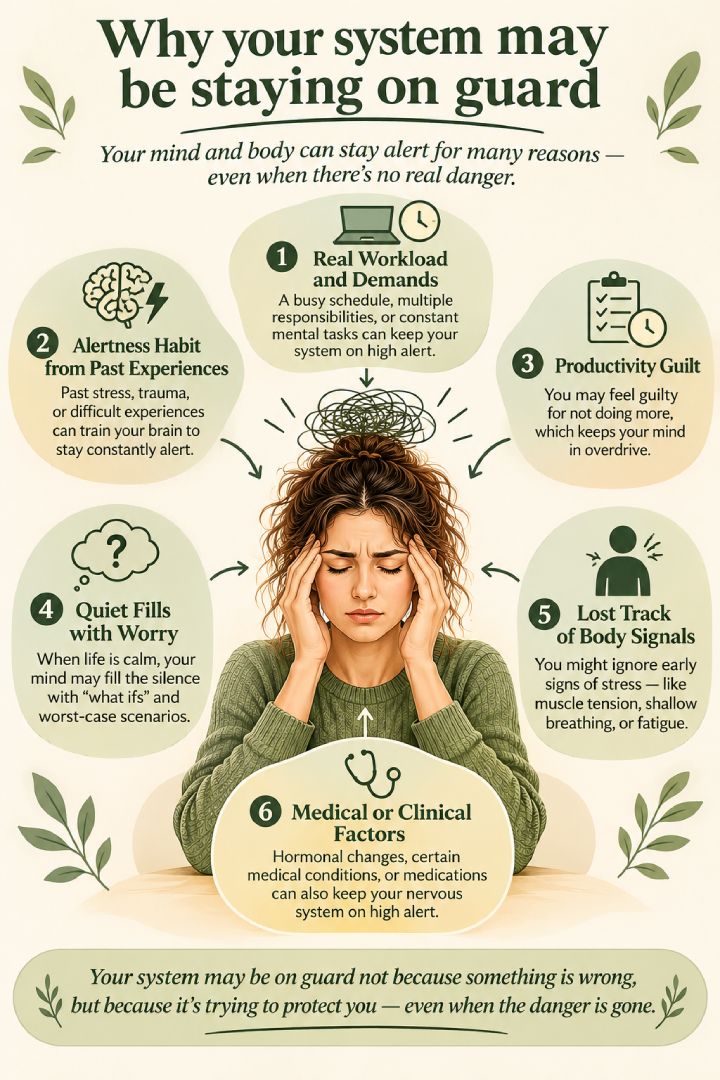
Why your nervous system may stay on guard
Several pressures can overlap. Some are part of your life now, and some shaped what you learned to expect.
Constant demands: When work follows you home or care depends on your being reachable, you may have very few stretches of time in which someone else is responsible.
Conditioning from your history: If you grew up listening for a change in someone’s tone, paying close attention may have helped you get through the day. That kind of watchfulness can carry into places where you have more room to let your guard down.
A heavy mental load: You can finish the visible work and still be the person remembering the school form, the refill, and the conversation everyone is putting off.
Rest tied to worth: If people valued you most when you were useful, an evening to yourself can feel like you’ve forgotten something you owe.
What this can look like
Feeling guilty or fidgety when you sit still
Reaching for your phone, a task, or a screen the moment things get quiet
Muscle tension, a clenched jaw, or shallow breathing without an obvious reason
Trouble falling asleep even when you're exhausted
A sense of dread with no clear source
Feeling more at home in chaos than in calm
Muscle tension and difficulty sleeping can have several causes. A clinician can help assess symptoms that persist or worry you. If you have chest pain or pressure, especially with shortness of breath, sweating, dizziness, or nausea, seek emergency medical care right away.
Pay attention to when this happens. An evening spent waiting for a message can feel different from an evening when someone else is taking the calls.
What makes it hard for you to rest?
Before trying to relax, take a moment to notice what your attention keeps returning to. These questions can help you get specific.
What demands have become so familiar that I no longer count them as stress?
What would need to change for me to be genuinely off duty? Who could share the responsibility?
Do I feel uneasy only in stillness, all the time, or around certain people or places?
What do I do the moment things get quiet, and what might I be avoiding?
An exercise may help you settle for a few minutes. You may also need someone to take over the evening care or an agreement at work about who answers after hours. Some demands are beyond what you can change on your own. That matters when you’re trying to make sense of why rest feels out of reach.
Small ways to make room for rest
If you’re somewhere you feel reasonably safe, give yourself a little time to see what kind of rest suits you. What feels restorative may change with the day you’ve had and the company you’re in.
Start small. Take a minute to sit somewhere comfortable and see how it feels. You can get up whenever you like.
Choose rest that fits you. Watering the plants may give you more room to breathe than sitting on the couch. So might a conversation with someone around whom you feel at ease.
Try gentle movement first if sitting still feels uncomfortable. A short walk or a change of position may feel more natural.
Notice what you feel. You might notice your shoulders rise when your phone lights up. What are you expecting to happen next? If there’s an immediate concern, consider what would help you address it or who could support you.
Slower breathing helps some people. If paying attention to your breath feels comfortable, you might try breathing a little more slowly. The National Center for Complementary and Integrative Health notes that relaxation techniques can sometimes increase anxiety. Stop if you feel more anxious, dizzy, or panicky.
If slowing down brings up more unease, you can pause and try something that feels more supportive. For more on what to do when familiar practices fall short, read How Do I Regulate My Nervous System When Nothing Works?
When to seek support
Consider speaking with a doctor or mental health professional if any of these patterns are familiar.
The tension or dread is constant or getting worse
It interferes with your sleep, work, or relationships
A history of difficult experiences still feels active
You're relying on alcohol, overworking, or other ways of coping to switch off
If you’re thinking about harming yourself, call or text 988 in the U.S. for crisis support. If you’re in immediate danger, contact local emergency services.
If this has become a constant background in your life, why you might feel anxious all the time is worth reading too.
From stress to coherence
I call the first movement of The Coherence Method™ From Stress to Coherence. Coherence is the capacity for what you sense, feel, and think to inform how you respond to the conditions you’re in. You can feel unsettled and still make a coherent choice. You might notice how tightly you’re holding your phone, realize you’re still waiting for a work message, and decide whether you need to be reachable tonight.
The next time the house goes quiet and you find yourself bracing, see what you’re still listening for. The answer might tell you something about what happened earlier that day, what you learned to expect years ago, or what’s still being asked of you. It might also tell you who you could ask to sit with you or take something off your hands.
Explore The Coherence Method™ Course
The Coherence Method™ Course is a self-paced educational program with 20 modules. It offers guided practices for noticing stress as it unfolds and exploring how you respond in everyday life.
You can also read more about the approach in the book, The Coherence Method™.
Frequently asked questions
Why do I feel anxious when everything is going well?
Anxiety can show up even when there’s no immediate threat. You might notice it once the day slows down, or find yourself expecting the next problem because you’ve had to anticipate so many. If the feeling persists or interferes with daily life, consider talking with a health professional.
Is it normal to feel guilty when I rest?
It’s common to feel guilty about resting if being useful has helped you earn approval or keep things running. Notice what the guilt is asking you to do. If it sends you straight back to a task, it may help to ask who else could take responsibility for it.
Can chronic stress change how I feel at rest?
Yes. Chronic stress can affect sleep, mood, and concentration. When demands keep coming, winding down can take time even after they ease. If symptoms persist or you’re unsure what’s causing them, a clinician can help assess other possible causes.
How long does it take to feel calm again?
The pace varies with what’s driving the restlessness, what’s changing in your circumstances, and the support you have. You may find it easier to unwind in one setting and still feel on guard in another. Consider seeking support if the difficulty persists or worsens.
When should I talk to a professional?
Talk with a doctor or mental health professional if difficulty relaxing persists or interferes with your sleep, work, or relationships. Seek emergency medical care for chest pain or pressure, especially with shortness of breath. In the U.S., you can call or text 988 for support if you’re thinking about harming yourself.
This article is educational and isn't a substitute for individualized medical or mental health care. Persistent or worsening symptoms deserve assessment by a qualified professional.
Sources
National Institute of Mental Health. I'm So Stressed Out! Fact Sheet. https://www.nimh.nih.gov/health/publications/so-stressed-out-fact-sheet
Mayo Clinic. Chronic stress puts your health at risk. https://www.mayoclinic.org/healthy-lifestyle/stress-management/in-depth/stress/art-20046037
Mayo Clinic. Stress symptoms: Effects on your body and behavior. https://www.mayoclinic.org/healthy-lifestyle/stress-management/in-depth/stress-symptoms/art-20050987
National Center for Complementary and Integrative Health. 5 Things To Know About Relaxation Techniques for Stress. https://www.nccih.nih.gov/health/tips/things-to-know-about-relaxation-techniques-for-stress
National Center for Complementary and Integrative Health. Stress. https://www.nccih.nih.gov/health/stress
988 Suicide & Crisis Lifeline. https://988lifeline.org